Aklima Akter Akhy
ID: 866
English Section
The biggest celebrations of our community are: Pohela Baishakh, Ei-dulfetor, Ei-dul Azha, Victory day, Independence Day etc. I like Pohela Baishakh. Pohela Baishakh is the first day of Boishakh month [1st month Bengali year]. It is a part and parcel of our culture and we observe this day with great festivity. Baishakhi Fairs are held in the different parts of the country. People of all classes go to the fair. The most comprehensive fair is held at the Ramna Batomul in every year. People wear colorful dresses representing Bengali trends and exchange gifts. Businessmen open new books of account on this day which is known as Halkhata. I go to Baishakhi Fair in every year at Ramna Batomul. I feel very much pleasure on this day. So Pohela Baisakh is the biggest celebration of our community to me.
Saturday, August 30, 2008

Tuesday, August 26, 2008
The Biggest Celebration In Our Country
Cross posted from Sristi Kotha
Bangladesh is a non-communal country, where Muslims, Hindus, Christians and Buddhists live together with common indicative Bangladeshi (Bangali). In turn of six seasons in this highly beautiful country, Bangladeshis overwhelm with various kinds of festive occasions such as Pahela Baishakh (1st day of new Bengali year), Borshaboron (reception of rainy season), Nobanno Utsab (celebration with new crops at Hemonta), Pahela Falgun (1st day of spring), Chaitra Songkranti (last day of Bengali year), National mother tongue day, Independence day besides different community’s religious festivals. But I think Pahela Baishakh is the biggest celebration where gay and festive Bangladeshis of various communities hold a festive of one spirit for the devotional reception of new Bengali year.
Bangladesh is a non-communal country, where Muslims, Hindus, Christians and Buddhists live together with common indicative Bangladeshi (Bangali). In turn of six seasons in this highly beautiful country, Bangladeshis overwhelm with various kinds of festive occasions such as Pahela Baishakh (1st day of new Bengali year), Borshaboron (reception of rainy season), Nobanno Utsab (celebration with new crops at Hemonta), Pahela Falgun (1st day of spring), Chaitra Songkranti (last day of Bengali year), National mother tongue day, Independence day besides different community’s religious festivals. But I think Pahela Baishakh is the biggest celebration where gay and festive Bangladeshis of various communities hold a festive of one spirit for the devotional reception of new Bengali year.
The first day of new year begins by wishing one another saying shuvo nababarsha (happy new year). Every one wears same type of dresses which are combination of red and white.Men use to wear Panjabi or Fotua and women wear Shari, some girls use Slack and Kameez. Girls are ornamented with Bengali adorn. They use henna paste, bangles, various types of ornaments made by mud, flowers etc. Some people use abeer (kind of red powder), some draw alpona on their face or hand. Every one have special food in this day which is panta (boiled rice soaked with water) with fried hilsa fish, uncooked onion, green chili and various kinds of bhorta (one kind of cooked food) of dried fish (preserved by seasoning and drying in the sun), potato, pulse or prawn.
 Picture: A Bangladeshi girl ornamented with Baishakhi adorn
Many organizations and institutions arrange rally. People gather in rally with colorful poster, mask etc. Baishakhi fairs and cultural shows are arranged here and there. Various types of toys, pottery, handicrafts, cosmetics, fan (of a palmyra-leaf), sweetmeats etc are available in fair. Jatra pala (Opera) and puppet show are attractive parts of village fair. All cultural functions in this day begins with a song by world famous poet Rabindra Nath tagore which is aso… hey baishakh, aso… aso (come… oh Bishakh, come… come). Cultural functions are resounded by song, dance and poetry recitation. Most colorful and quite attractive fair and cultural functions are arranged at Romona Botomul in Dhaka. Sometimes storm called Baishakhi jhar occur suddenly. Then owners of stores in fair fall in hazard little bit.
Some indigenous people such as Chakma, Marma, Tonchonga and Tripura celebrate this day as their main festival which is called Bijhu. They are overwhelmed with indigenous festival.
 Picture: floor decoration
As a Bangladeshi I also enjoy this day with others of one spirit. In my childhood I and my friends bought vandar (one kind of pot made by mud) from Baishakhi fair and saved money in it all around the year and in next new year we bought new dress by this money. It was a great pleasure to me. In this day we were walking about in the village fair. Riding in Nagor- dola and designing hands with color were the main attraction for me. When I was a student of college, then I and my friends gathered at college campus at the starting of day and then traveled by boat in the river called Bhairab. We passed our time with singsong, gossip, laugh etc. At afternoon we went at fair. The years after that I was a resident of Rokeya hall at University (KUET) and here pleasant drowsiness of festival for reception of new year begins at previous night of this day. Some girls were busy with rehearsal of sing song, poetry recitation, some were busy with making poster, some were drawing alpona (floor decoration of sprinkled rice flour) at hall courtyard, some were busy with designing their hands by henna paste, some were making cake for stall, some were going for festooning campus with posters. The night was passed in this way. At morning festival was started with cultural function. Some girls put mark of sandal paste on the forehead of others during the function. At the end of function we took special food for Pahela Baishakh. Then we went to the stalls held by some students of the university and after that we walked about various place. We also enjoyed film show at university auditorium.
 Picture: Designed hands with henna paste
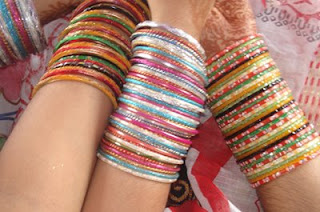 Picture: Hands are ornamented with bangles
Like me all Bangladeshis enjoy this day. At one time this day takes farewell from us but it offers new dreams for new days and says, “happy every day of new year”.
The biggest celebrating day
By Syeda Mahmuda Akhter
Our life is the sum total of hours, days and years. But all days are not equally memorable to us. Eid-ul-Fitr is the biggest religious festival of the Muslims across the world. The Muslims celebrate the day after day long fasting throughout the month of Ramadan. This day bears great significance to the Muslims. They eagerly wait for this day after keeping away from all sorts of vices during the Ramadan. On this day the Muslims come closer to one another forgetting all enmity & hatred among themselves. This day brings immense joy & happiness to them. On this day, children’s joy knows no bounds. Wearing new dresses, they move from house to house & eat delicious foods. On this day, the Muslims get up early in the morning. After saying their morning prayer, the take bath & then put on new dresses & go to Eidgah to say Eid prayers. They pray not only their personal well-being but also for the salvation of humanity in the Eid prayer. After the prayer, they embrace each other & exchange greetings saying Eid Mubarak. On Eid occasion, I cooked many delicious foods. My friends and relatives visit my house to exchange Eid greetings. On this day before, I exchange many interesting messages to my near & dear ones.
I enjoyed this day very much. My husband along with my only son “Areed” I visit my close friends & relatives house and share Eid greetings.Our life is the sum total of hours, days and years. But all days are not equally memorable to us. Eid-ul-Fitr is the biggest religious festival of the Muslims across the world. The Muslims celebrate the day after day long fasting throughout the month of Ramadan. This day bears great significance to the Muslims. They eagerly wait for this day after keeping away from all sorts of vices during the Ramadan. On this day the Muslims come closer to one another forgetting all enmity & hatred among themselves. This day brings immense joy & happiness to them. On this day, children’s joy knows no bounds. Wearing new dresses, they move from house to house & eat delicious foods. On this day, the Muslims get up early in the morning. After saying their morning prayer, the take bath & then put on new dresses & go to Eidgah to say Eid prayers. They pray not only their personal well-being but also for the salvation of humanity in the Eid prayer. After the prayer, they embrace each other & exchange greetings saying Eid Mubarak. On Eid occasion, I cooked many delicious foods. My friends and relatives visit my house to exchange Eid greetings. On this day before, I exchange many interesting messages to my near & dear ones.

Although Eid-ul-Fitr is a day of festivity, it teaches us to love all men irrespective of high & low. It reminds us of the saying “Malice towards none but love for all under the sun.”
Monday, August 25, 2008
The biggest celebration in my community
By Jainub Khanam
 When the moon of eid arises in the evening, everybody feels very happy . In Eid day all forget that who poor and who rich man. All share the pleasures to one another. All men wear new dress. Everybody go to meet with their dearest in their house and give good wishes and gift etc. we, the housewives cook shemai, biriani, khir and other delicious foods. At the end, I want to say that Eid-ul-fitr is very enjoyable day for me. That’s why I think Eid day is biggest celebration of our community each year.
We are Bangladeshi and Muslims. Bengali celebration days are 21st February –martyrs and international mother language day , 26th march independence day, Pohela Baishak-Bangla new year.26 march is very important for me as Bangladeshi. Because, we have got our Bangladesh by giving blood of million martyrs and honor of many mothers and sisters. I am thankful and regarded to them. Since, I am Muslim. So, very important for me like birth and death day of Mohammad(sm) in 12th Rabiul awal , Shob-e-barat, Shob-e-meraz, Eid-ul-fitr, Eid-ul-azha, etc.
Eid –ul-azha teaches us how to sacrifice for others. But I like very much Eid-ul-fitr. Because the Eid day is the greatest of all festivals of the Muslims in the world. After the month long Ramadan the Eid-ul-fitr knocks at the door. In this way, all muslim does pure and innocent their heart and soul.When the moon of eid arises in the evening, everybody feels very happy . In Eid day all forget that who poor and who rich man. All share the pleasures to one another. All men wear new dress. Everybody go to meet with their dearest in their house and give good wishes and gift etc. we, the housewives cook shemai, biriani, khir and other delicious foods. At the end, I want to say that Eid-ul-fitr is very enjoyable day for me. That’s why I think Eid day is biggest celebration of our community each year.
Saturday, August 23, 2008
How Nari Jibon students/new bloggers are trying to go ahead
Cross posted from Sujan's Chinta

 Ahsan Manzil and (second) its display centre.

 Nari Jibon bloggers are taking photos of Ahsan Manzil

 Nari Jibon bloggers are introducing themselves with other visitors (foreigners) and inviting them to visit Nari Jibon. Jesmin and Jannath are talking in English with two Japanese and other people are listening to their conversation. Jesmin and Jannath are learning English at Nari Jibon.
 We became sad when we saw the water of our Buriganga River is being polluted by the people and businessmen of this area and nobody care of this.
To develop Nari Jibon new bloggers, Nari Jibon arranged a photo session in last Friday (22 August 08). Four student bloggers (Jesmin ara Amzad, Jannat ara Amzad, Hira and Sufia), Nari Jibon staff blogger & Trainer Taslima Akter and Golam Rabbany Sujan went to visit Ahsan Manzil. They also visited and took pictures some of adjacent areas of Ahsan Manzil like Jagannath University and banks of Buriganga River, Victoria Park etc. Some of Nari Jibon students who receive skill training on English and Computers open blog addresses. Nari Jibon students also receive training on writing feature on different things in their classes, blog training, and digital camera operating etc. Some of them also open flickr accounts. As all the students bloggers have no own digital camera Nari Jibon authority arrange outside photo session for the students & regular bloggers. We think it will improve students’ knowledge and they will be motivated to keep more blogs.
Ahsan Manzil and (second) its display centre.Ahsan Manzil was named by Nawab Khwaja Abdul Ghani after his son Nawab Khwaja Alimullah during the time of Mughals. It was built up during the time of Mugahls and it was used by Dhaka Nawab family. It is situated on the bank of the Buriganga River. Now it is using as a museum.
Nari Jibon bloggers are taking photos of Ahsan ManzilNari Jibon bloggers are introducing themselves with other visitors (foreigners) and inviting them to visit Nari Jibon. Jesmin and Jannath are talking in English with two Japanese and other people are listening to their conversation. Jesmin and Jannath are learning English at Nari Jibon.We became sad when we saw the water of our Buriganga River is being polluted by the people and businessmen of this area and nobody care of this.Wednesday, August 20, 2008
My mother

Last winter I went to Barisal along with my children and wife to see my mother and also to observe Eid-ul.Azha. My mother was very much happy to see us that time. Seeing us she got some strength to walk a bit. My mother is now Eighty five years old. Due to old age she can not walk well without help of others or stick. She lost her parents and four of her brothers long long ago. She also has lost her husband and two sons that made her weaker.

Mother with my two sisters
In our village everybody loves her for her hospitality. My mother lives in village along with her youngest daughter and grand daughter. But my sister has to cook five to six peoples food everyday. Neighboring people ( specially women come to see her, chat with her and helps my sister a bit in her household works but nobody can not go without having food from our house. I saw her keeping without food many times but she told us that she had no appetite but checking the rice dish I saw empty. Actually she gave food to some of her poor neighboring children that was for her. Even now no one can go from our house without having food.
Her heart is great that is hardly seen. I do not know how to explain about her big heart. She is so affectionate to all.My mother is living in village where my father and two elder brothers were buried. We tried to take her Dhaka but she does not want to leave that place. She says in this respect that she can see her two son’s everyday but if she is taken to Dhaka how she would see them.
As she is living far away from Dhaka and very expensive to go over there; I can not go to see my mother whenever I want. I usually go to village once or twice a year specially in Eid vacation. But I try to talk to her almost every day over cell phone. Whenever I talk to her my heart fill with joy and happiness. I love my mother very much.
World of Today
By Sufia Khatun
World of today .As like today,
Life stays long? Or not stay?
If this world does not stay,
All human nations will go to be change,
World of today is very nice,
It makes our mind anxious,
Mind does not want to listen any thing and the hart is same ,
I don’t wish to leave this world,
We all want more and more,
World of today may not change.
World of today .As like today,
Life stays long? Or not stay?
If this world does not stay,
All human nations will go to be change,
World of today is very nice,
It makes our mind anxious,
Mind does not want to listen any thing and the hart is same ,
I don’t wish to leave this world,
We all want more and more,
World of today may not change.
My brother
By Sufia Khatun
I am Sufia. We are three sisters and one brother. I have father, but he doesn’t live with us. I have mother. She is a housewife. My brother is only on earning person in our family. Our family depends on him. I did not any cares from my father. But I don’t know about affection and love of my father. My brother loves me so much. He believes me. He passed S.S.C in 1994. From that he is working hard for our family. I am very proud of my brother. Because, he is my brother, he is my father, he is my friend and he is my all. I pray all time for my brother. May he stay good and God bless him. My brother is a best brother for me. I best happy for my brother.
I am Sufia. We are three sisters and one brother. I have father, but he doesn’t live with us. I have mother. She is a housewife. My brother is only on earning person in our family. Our family depends on him. I did not any cares from my father. But I don’t know about affection and love of my father. My brother loves me so much. He believes me. He passed S.S.C in 1994. From that he is working hard for our family. I am very proud of my brother. Because, he is my brother, he is my father, he is my friend and he is my all. I pray all time for my brother. May he stay good and God bless him. My brother is a best brother for me. I best happy for my brother.
What is the biggest celebration of your community each year?
Nasrin Akter Urmi [ID: 879]
English Section
Our country has many occations, as like: Eid-ul-Fitre, Eid-ul-Azha, Pahela Baisakh, Pahela Falgun, 21st February etc. I think eid day is the biggest celebration of our community each year. Eid day is special day in our Muslim life. Eid-ul-fitre takes place on the first day of shawal after having one month of Ramadan. On this day all rise from sleep very early. All men and young boys go to the Eidgah Mosque to say their prayer. On this day every body wears new dress and visits to one another's house. Various items are cooked on this occation. The rich people distributen cloths, foods and money among the poor.
What is the biggest celebration of your community each year?
Rabaya Akter [ID: 893]
English Section
In our community we have several special days. We celebrate these days each year. There are many special days to celebrate, but one of the biggest celebrations in our community is Pahela Baisakh and all the people of Bangladesh
What is the biggest celebration of your community each year?
Sonia Yeasmin [ID: 888]
English Section
our country celebrate many days like Pahela Baishakh, Eid-ul-Fiture, Eid-ul-Azha ,Victory day and 21st February etc. but I think victory day and 21st February is the biggest celebration of our community each year. Because our country was controlled by others but we have gotten our independence on 16th December in 1971 through the blood of 30 lac martyred. The Independence Day is ovserved all over the country with various programs. On that day parade of different armed forces is held in the race cours maidan apart that various play and cultural programs are held in other parts of the country. Boys and girls of the school and college make anaado [joy] rally. The 21st February is an international mother language day. Mother tongue is a divine gift. Some of the heroic sons came forward and sacrificed their glorious life for the cause of our mother tongue on the 21st February 1952. Rafique, Jabber, Salam , Barkat were shot. Since then this day is called the Shaheed Dibash. Now it is a great pleasure for us that this day has got international recognition in 1999. The victory day and 21st February create pleasures in the mind of people of every profession and religion. So we celebrate victory day and 21st February very gorjiously.
The Largest Celebrations of my communities
Cross posted from Afrin’s Gallery
Mainly there are four communities in our country, Bangladesh. Among them, one is Muslim. Even I am a Muslim and so I belong to Muslim community. Most of the people of our country are Muslims. In my community, we the Muslims celebrate the celebrations of this community such as Eid-Ul-Fitre, Eid-Ul-Azha, Shab-e-Meraz, Shab-e-Borat, Shab-e-Kodor, Eid-e-Miladunnabi, Ashura, Akheri Chahar Shomba and Fateha-e-Iazdahom. We celebrate them honestly by absorbing all day in praying of Almighty. In my opinion, I think the largest celebration of this community is Eid-Ul-Fitre. The reason is that we get it after fast adoration of one month in Ramzan. It is the first day of Zilkod. We celebrate it cheerfully in each year. On that day, the whole country wears a festive look. We wear new dresses, say our prayers to Almighty and give money or cloths to the poor. Lastly, we spend the whole day by walking about many places or relatives house and greet them calling ‘Eid Mubarak’ and enjoy all day long. The day is an auspicious day for everybody that we wait for eagerly. In another side, I am a Bengali too because my mother tongue is Bangla. In Bengali tradition, we observe the first day of Bengali New Year excitedly because from this day, a new year starts. The first day is in the month of Baishakh that belongs to summer season. So we call the first day ‘Pahela Baishakh’ and greet all calling ‘Shuvo Hok Noboborsho’ in Bengali. We choose it very gloriously with our traditional festivities of Bengali. We eat watered rice with Hilsha fish, chilies and onion. Many women wear white saris of different designs and men wear pajama-Punjabis. Some women put garlands of jasmine on hair. The other Bengali festivals are the first days of every season. However, from my own view, the largest celebration of Muslim community is ‘Eid-Ul-Fitre’ and ‘Pahela Baishakh’ is in Bengali community.
Mainly there are four communities in our country, Bangladesh. Among them, one is Muslim. Even I am a Muslim and so I belong to Muslim community. Most of the people of our country are Muslims. In my community, we the Muslims celebrate the celebrations of this community such as Eid-Ul-Fitre, Eid-Ul-Azha, Shab-e-Meraz, Shab-e-Borat, Shab-e-Kodor, Eid-e-Miladunnabi, Ashura, Akheri Chahar Shomba and Fateha-e-Iazdahom. We celebrate them honestly by absorbing all day in praying of Almighty. In my opinion, I think the largest celebration of this community is Eid-Ul-Fitre. The reason is that we get it after fast adoration of one month in Ramzan. It is the first day of Zilkod. We celebrate it cheerfully in each year. On that day, the whole country wears a festive look. We wear new dresses, say our prayers to Almighty and give money or cloths to the poor. Lastly, we spend the whole day by walking about many places or relatives house and greet them calling ‘Eid Mubarak’ and enjoy all day long. The day is an auspicious day for everybody that we wait for eagerly. In another side, I am a Bengali too because my mother tongue is Bangla. In Bengali tradition, we observe the first day of Bengali New Year excitedly because from this day, a new year starts. The first day is in the month of Baishakh that belongs to summer season. So we call the first day ‘Pahela Baishakh’ and greet all calling ‘Shuvo Hok Noboborsho’ in Bengali. We choose it very gloriously with our traditional festivities of Bengali. We eat watered rice with Hilsha fish, chilies and onion. Many women wear white saris of different designs and men wear pajama-Punjabis. Some women put garlands of jasmine on hair. The other Bengali festivals are the first days of every season. However, from my own view, the largest celebration of Muslim community is ‘Eid-Ul-Fitre’ and ‘Pahela Baishakh’ is in Bengali community.
Saturday, August 16, 2008
Nari Jibon Project and Its Bloggers: What Other Bloggers are Saying
Cross posted from bideshi blue
 Students in the computer lab.....
 some bloggers' photography session with Ms. Kira:
Zannat, Jannat, Choti, Kira, Jainub's daughter, Jesmin
http://el-oso.net/blog/archives/2008/08/15/an-update-from-nari-jibon/en/
http://rising.globalvoicesonline.org/blog/2008/08/14/nari-jibon-making-a-difference/
http://uncultured.com/2008/07/25/what-would-kathy-do/
http://www.k-minos.com/?p=577
http://rising.globalvoicesonline.org/blog/2008/07/10/nari-jibon-the-joy-of-having-their-own-blog/
Some Students’ blog addresses:
Afrin's Gallery http://asiaafrin.blogspot.com/
Jesmin’s garden http://jesmingarden.blogspot.com/
Zannat's world http://zannatworld.blogspot.com/
Rainbow http://jannat-fardoush.blogspot.com/
Bangladeshi Women http://jainub-khanam.blogspot.com/
Ahona http://ahona-hira.blogspot.com/
Window of Mind, http://sufia-eti.blogspot.com/
My Dream, http://poly-dream.blogspot.com/
Choti’s blog http://choitrerdinguly.blogspot.com/
Staff blog addresses:
new ! Kajol's destiny http://kajols-destiny.blogspot.com/
Bipa’s Prokrito Bangladesh http://www.bipa-prokritobangladesh.blogspot.com/
Sujan’s Chinta, http://hi-bangladesh.blogspot.com/
Creative talk by Nilufa http://annekuet.blogspot.com/
Kazi’s eye, http://kazi-rafiq.blogspot.com/
Techna Tara: http://taslima-toma.blogspot.com/
Students in the computer lab.....Recently I returned from 45 hot (beshi garum) days in Bangladesh where I visited the Nari Jibon Project, among other activities. Loadshedding continued to take its toil on me, Nari Jibon computers, students as well as garment factories. Nonetheless students have come to their computer and english classes as well as practiced in the women only cyber cafe. During this visit, many students opened their own blogs!
During this time, Nari Jibon hosted a visiting lecturer, Kira, who gave a lecture and worked with smaller groups on blogs, photography, photo websites.
In response, many students posted in the Nari Jibon english blog for the first time. Other students have continued to contributed to Nari Jibon bangla blog. Many of the bangla poems have been translated into english and posted in the english blog. Some students opened their own blogs (in English and Bangla) and some staff started blogging again...
some bloggers' photography session with Ms. Kira:Zannat, Jannat, Choti, Kira, Jainub's daughter, Jesmin
For overviews of these blogging activities, check out what others have been saying about Nari Jibon and its bloggers. Please follow the links within and read the bloggers' creative activities as they find and develop their own voices and computer-photo skills and continue to post. Your comments (kind, thoughtful, constructive) will provide much needed encouragement. Below, I list some students' and staff members' individual blogs.
new from David Sasaki's visit to Dhaka and Nari Jibon Project:
http://rising.globalvoicesonline.org/blog/2008/09/02/nari-jibon-using-blogs-to-give-bangladeshi-women-new-skills/
new ! http://el-oso.net/blog/archives/2008/09/02/bangladesh/en/
new from David Sasaki's visit to Dhaka and Nari Jibon Project:
http://rising.globalvoicesonline.org/blog/2008/09/02/nari-jibon-using-blogs-to-give-bangladeshi-women-new-skills/
new ! http://el-oso.net/blog/archives/2008/09/02/bangladesh/en/
http://el-oso.net/blog/archives/2008/08/15/an-update-from-nari-jibon/en/
http://rising.globalvoicesonline.org/blog/2008/08/14/nari-jibon-making-a-difference/
http://uncultured.com/2008/07/25/what-would-kathy-do/
http://www.k-minos.com/?p=577
http://rising.globalvoicesonline.org/blog/2008/07/10/nari-jibon-the-joy-of-having-their-own-blog/
Some Students’ blog addresses:
Afrin's Gallery http://asiaafrin.blogspot.com/
Jesmin’s garden http://jesmingarden.blogspot.com/
Zannat's world http://zannatworld.blogspot.com/
Rainbow http://jannat-fardoush.blogspot.com/
Bangladeshi Women http://jainub-khanam.blogspot.com/
Ahona http://ahona-hira.blogspot.com/
Window of Mind, http://sufia-eti.blogspot.com/
My Dream, http://poly-dream.blogspot.com/
Choti’s blog http://choitrerdinguly.blogspot.com/
Staff blog addresses:
new ! Kajol's destiny http://kajols-destiny.blogspot.com/
Bipa’s Prokrito Bangladesh http://www.bipa-prokritobangladesh.blogspot.com/
Sujan’s Chinta, http://hi-bangladesh.blogspot.com/
Creative talk by Nilufa http://annekuet.blogspot.com/
Kazi’s eye, http://kazi-rafiq.blogspot.com/
Techna Tara: http://taslima-toma.blogspot.com/

Two more success history of Nari Jibon students
By Golam Rabbany (Sujan)
 Sweety is making dress at her house
 Papia is making dress at her house
Sweety started home based tailoring business at the end of her course duration of Nari Jibon. Last July’08 she earned 800 taka from her home based tailoring business. Sweety completed ‘Tailoring Cutting and Sewing Master Course’ from Nari Jibon recently. She learned there 34 tailoring items successfully. Now she can make various kinds of Children and women’ dresses, pillow covers, curtains, fotuya, panjabi, maxi, shorts and shirts, veil etc.Sweety is about 18 years old and unmarried. She studied up to class-8. After passing class-8, her parents were unable to prosecute her study as then they faced serious financial crisis. Then she quitted her study and started to work in the garment factory. But her parents and relative did not like her working in the garment factory. After working one year in the garment factory, she gave up continue her job. After that she was passing her time at their house. Being informed about Nari Jibon from her younger sister she took admission at Nari Jibon to learn tailoring items.She took admission at Nari Jibon dated 1st March 2008. She used to take class regularly and she was attentive to learn tailoring items. She got tailoring scholarship from Nari Jibon. That’s why she used to get chance practice more time and as a result she became very expert to make dresses. She started to work in the home based tailoring business from last June.
Sweety is making dress at her houseSweety is thinking that she will set up a tailoring shop in a village market near her village with her younger sister who is working in a tailoring shop and she is also a graduate student of Nari Jibon. She already talked with her parents and they are also agreed with her plan. Her parents will also leave Dhaka.
Papia akter is about 23 years old. She could not read or write though she went to the school about one year at her childhood. She worked in the garment factories more than ten years. Due to being pregnant she gave up working in the garment factory at the beginning of 2005. Papia and her husband were not agreed to start working in the garment factory again due to their small baby. Papia heard about Nari Jibon from one of her neighboring girl who was also a student of Nari Jibon. Then she took admission to learn Bangla as she was interested to learn tailoring items. She took admission dated 15th February 2008 in Bangla section and Tailoring section.Now Papia can read and write Bangla and also she has learned English alphabets and some small words. She also can read and write numbers (English, Bangla), addition, subtraction and multiplication etc. Still now she is coming to Nari Jibon for more study. Papia also completed Tailoring Cutting and Sewing Master Course from Nari Jibon successfully. She learned 32 tailoring items. She practices long time at Nari Jibon and she also completed her internship. After being admitted at Nari Jibon Papia applied for scholarship. Then she was facing financial problem as she had to spend a good number of money during her delivery period. As she was regular, attentive and poor student Nari Jibon provide her scholarship to learn tailoring items well. She used to get long time to learn and practice at Nari Jibon that helped her being expert tailoring master.
Papia is making dress at her houseNow, she can make all kinds of child dresses, Pillow cover, curtain, Salower, kamiz, various designs of three pieces, Panjabi, Fotua and other women’ dresses. Last August’08 she bought a sewing machine as she wanted to run home based tailoring business. Last July’08 Papia earned more than 700 taka making dresses of her neighboring people. Now Papia does not want to take job to any garment factory or any tailoring shop as she is to look after her small daughter. But she wants to run her home based tailoring business. In future she will try to expand her business like as she will keep some assistant tailoring workers and she will circulate her business and collect more dress making order etc.
Biggest celebration in my community
Cross posted from Sujan's Chinta
How we celebrate these festivals-

 (Villagers are working together and sharing the korbani with everyone)
 This is a file from the Wikimedia Commons.
We have many religious and cultural festivals in our society that are celebrated from the ancient period. We have two EID festivals, Sob-e-borat, Sob-e-kodor, Pohela Boishak (First day of Bengal New Year), First day of spring, Akushe February (Language Day), 16th December (Independence day), Nobanno utsab (festival of eating newly grown autumnal rice in the month of Agrahayan), etc
I think EID festival (EID UL FITRE and EID UL AJHA) and Pohela Boishak (First day of Bengali New Year) and Akushe February are our biggest celebrations in our community.How we celebrate these festivals-
EID festivals:We (Family members and nearest relatives) get together during EID festivals as all the service holders have EID vacation. Our family members may live different places in the country but most of them come to our birth family. All the family members try to buy gift (new dress) for his/her and for other family members. Every family cooks rich food of different items. Married daughters are invited with their husband and children. Young children receive salami (tips). Many people fix their marriage date or other parties during these vacations.All the people of the society pray their EID namaj in an open place and greet (each other) warmly. Every people in our society become happy and stay in pleasure during EID days. There are some religious values that make our society happier like as we provide some money as Fitra, Jakat to the poor people in our society. We (who have ability) also try to provide new dresses or some money to the poor people in our society. People in our society also try to get the good wishes of Allah by the helping of others.
(Villagers are working together and sharing the korbani with everyone)Some people provide immolation of a beast (Korbani) in the EID-ul Ajha and all the families in a community share these (meat) among themselves. Only poor people also get the skin or price of the skins of these beasts. All of these activities make all the people happy, unity and peace to live together in our society.
Pohela Boishak (First day of Bengali New Year) People in our society also celebrate Pohela Boishak (First day of Bengali New Year). It is also an enjoyable day in our society. Women and girls wear red and white colored sharee with soil-ornaments. Almost every child and other people wear cotton, colored, new or clean dress. They visit boishaki fair. There is an ancient landlord’s house in our locality including several large open fields where boishaki fair take place every year. We heard that landlord used to arrange boishaki fair after taking tax and to declare new tax rule. Now we have no landlord to take tax but we have the culture. People sing local and ancient folks, also enjoy horse race, different games like ha-du-du, kapadi, football etc. Young people get salami (tip) from the seniors. There are many games for young people and they can also buy various toys, various items of first food etc.
Akushe February (21st February)Ekushe February (21st February) is our mother language day. Now it is International mother language day. Pakistani ruler wanted to set up Urdi as national language in east Bengal (Present Bangladesh). Students, factory workers, businessmen, farmers and people of every sector started to protest against this declaration and on 21 February 1952 students and political activities were killed by the Pakistani police who were protesting and demanding Bengali as their mother language. This agitation encouraged Bengali to be independent. So we celebrate this day from our heart every year. This day we awake up from the sleep very early in the morning. We go to the Shahid Minar (martyrs monument) on foot and we give flowers to the Shaheed Minar before sunrise. This day we don’t wear shoes. Young people make Shaheed Minar in lane to lane and area to area though every school, college and university has one Shaheed Minar. Highest amount of flowers are sold in this day. Every cultural and other organization arranges various programs in this day like Moncho natok (stage play), song ceremony etc. Schools and Colleges arrange their Yearly Play and Price ceremony in this day.Thus we enjoy whole day with our friends and family members.
 This is a file from the Wikimedia Commons.
Subscribe to:
Posts (Atom)


