Purpose of Narijibon Blog

Nari Jibon Project seeks to increase our students’ and staffs’ abilities through different ways: classes, practice, computers, internet, and now the Narijibon Blog. Readers and writers (our students & staff) of the Blog will both learn about our lives, culture, Nature, activities of people in Bangladesh and the Nari Jibon Project.

Friday, July 6, 2007

Bangladeshi Handicraft: “Nakshi Katha”

In our Bangladesh we have improved on handicraft business. We are also exporting our handicrafts to foreign countries. We are being appreciated from those countries for our nice handicrafts. We can introduce our country with the other countries through this business. This type of business is helping to reduce our unemployment problem. Women are also working on handicraft. I feel that it is a good sign for Bangladesh. We have different handicraft businesses. Among them Nakshi Katha is a famous handicraft. It is not only famous in Bangladesh but also in other countries. A framed Naksi Katha increases the beauty of a room by hanging on a wall. It is used at home, office, shopping complex etc. In the rural area of Bangladesh “Nakshi Katha” is a common handicraft. It is an art of neglected village women. Sometimes, some fashionable women of rural area pass their leisure period by designing Nakshi Katha. Nakshi katha is a tradition of village. It takes tatters, cotton and needles to weave a Nakshi Katha. Women weave it with their creative skills. They make special designs with different pictures on it with the colorful cottons. It takes three or four months to make a nakshi katha for a woman. It is mainly used for bed sheet and blanket. The Bangladeshi people feel proud for this. Nakshi Katha can be used as a gift item for new couple, especially from bride family in the rural area.

The seller was showing Nakshi Katha in the fair - picture by Taslima Akter

Now Nakshi Ktha is a famous and fashionable item of handicraft in the urban area. We can buy Nakshi Katha from different fair, shopping centre etc. In the fair most of the seller are women. The shopping centre Aarong is famous for Nakshi Katha design. The designs show the Bangladeshi culture.
Written by Shahana Akter Munia

Historical Place of Bangladesh: Pictures of Sonargaon

Pictures taken by Animesh Chandra Bain


Friday, June 29, 2007

A Tale of 26 February, 07: Fire on BSEC Bhaban-2

At that night Begum Khaleda Jia came to the patient. She did not do anything for them. She was asking funny question. Then she left the place. Next day the opposite leader Shekh Hasina came and gave 10,000 taka to them. 50, 000 taka was given to five patients. After three days he was discharged from the hospital. 10,000 taka was not sufficient for him. There were thirteen broken bones in his ankle. But the money wasn’t sufficient for him. From February to till now 60,000 taka has been spent for him. He came back home on 13 March. After returning home through his office by the Government he was given more 10,000 taka. The death people’s families were given 1 lac taka. This 20,000 taka can’t recover any injured person at present day. In our country for primary treatment we need enough money .Those weren’t sufficient money to get proper treatment. With the blessing of Allah, he over came his broken leg with one bandge. Now he can’t walk without a stick. Already he started to go to office with his injured leg. He has a burden family on his head .He has two daughters and two sons and they are students till now. The elder sister is married. She lives at her father-in-law’s house. The younger daughter can’t continue her study regularly because she has younger brohers.They also need to study. For this she is trying to earn something with her best, that will be helped she to continue her study. Md. Azizur Rhaman is an honest man for his accident he is suffering for money. He needs a strong support by mentally and economically.

I wish that, Allah must help him again and build up his children’s career for the strong support. He never accepts his daughters support without his sons’. So, the sons need better study.

written by Ayasha Siddika

My Favorite Season

I am Kaniz Fatema Kanta. Here I will share my thoughts about my favorite season.

My favorite season is Rainy Season. We know that Bangladesh is a land of monsoon .There is six seasons in Bangladesh. Each season has its own features. We can see new scenery in each season. When new seasons come, the natures become change. The people also feel different in each season. The rainy season is one of them.

The rainy season comes after summer. During the months from June to August, the monsoon wind blows from the south-west and brings heavy showers. The rainy season is most welcome to people because of relief from excessive heat. The sky becomes overcast with clouds and we can’t see the sun light. Sometimes it goes on raining for some days. The rainy season is a season when there happen continuous rainfalls. Ponds, canals, lakes and rivers become brimful. The roads become muddy some where. The roads are sunk by water almost every where. People come out carrying umbrellas. People life comes to a standstill. In Bangladesh there are many people who live on the footpath in open air, they have no shelter during the rainfall. They are to face danger during the rainy season. Often the schools and colleges remain closed. Some people are thinly attended in the office. Shops and market places become customer less. Day laborers and beggars suffer a lot.

The rainy season is a great blessing for our country. Cause our agriculture depends on this rain. If the rain does not come in time, our farmer won’t be able to leave a good harvest. Some times it rains so heavily that it causes flood and bring untold miseries to people. Some people dislike the rainy season. But I feel that there is a joy in watching the dark clouds and hearing the sound of rainfall. The nature looks fresh and green. That’s why I like the Rainy Season most.

written by Kaniz Fatema Kanta

Monday, June 25, 2007

The people of Bangladesh

Bangladesh is a small low –lying country in the South Asia. Bangladesh becomes independent in 1971 at the cost of supreme sacrifice of many valiant people. The ancient city Dhaka is the capital of Bangladesh. It is a very poor and populated country; Poverty is a great problem for our country people. Many people live in village. Many people are not educated. Now I am trying to describe about the men, women and children of Bangladesh.

Men: Many people are farmers. Most of the farmers are not educated. They are not able to send their children to school because of their poverty. They work hard in the field for a long time. Some farmers work in the field with their children. They think that their children don’t need education. The people of city always remain busy for their works. They go to office in the morning and return home at night. Many poor people live in the city. They are rickshaw puller, taxi driver etc. Sometimes the people of city go to travel with their family. The village people do not get spare time. When they get some spare time, they pass this time by gossiping, playing cards, listening stories, enjoying jarigan, sharigan, kabigan and by playing some country games like ha-du-du etc.

Women: The women of the city always remain busy for their works. Many educated women are working at office. Many educated women are teaching at schools, colleges and universities. Some educated women are teaching on computer courses. Many uneducated women live in our country. Some uneducated women work at many garments factory. Most of the women remain busy for their house hold work. The women of the city spend their time going out side with their families. The poor women spend their time by gossiping. Some women work with their husbands in the field. Some women sew Nakshikatha and sell those.

Children: The Bangladeshi street children are rootless. Everybody have some ideas about the street children of Bangladesh. The real picture of these street children is very pathetic. They are shelter less. They have no particular living or sleeping place. They sleep on the street. Some of them beg on the street. They may have parents. But their parents do not take proper care of them. they do not get any opportunity to go to school. They are complete illiterate. It is a matter of great regret. Today’s child is tomorrow’s future. So all of us including the government should take necessary steps; that they can enjoy their legal rights.

Written by Tahmina Akter

Wednesday, June 13, 2007

Street Child of Dhaka City

The picture is taken by Animesh Chandra Bain

The childred are returning to the slum in the afternoon.

Monday, June 11, 2007

Life of a Rickshaw Puller in Dhaka City of Bangladesh (Rickshaw Puller of Bangladesh)

Written & pictures taken by Taslima Akter

Rickshaw is the most important transport of Bangladesh. The driver of risqwa comes from the lower level in Bangladesh society. Many people are driving Rickshaw for livelihood. Almost Rickshaw puller comes from the village of Bangladesh. The village of Bangladesh has no enough job opportunities I want to write something about Rickshaw puller of Bangladesh. I have talked with a Rickshaw puller. His name is Misir Ali. Miser Ali has born Comilla. He is 72 years old. He has been driving Rickshaw from 1972 in Dhaka city. He got married when he was 22 years old. He is father of 6 sons and one daughter. He has no idea about family planning. Though he has big family but he was happy with his family members. He is illiterate. He doesn’t know how to read and write. He has to face a lot of problem because of his illiteracy. He wanted to make educated his sons. But they are not interested to go school. His some sons are driving Rickshaw and some are run business. But they are no taking care to him. Every son is got married and they are live separately. Rickshaw driving is hard work. Now Misir Ali can’t drive Rickshaw like before. He has lost energy to driven. Now he has driven Rickshaw 3-4days in a week. Now he wants to take respite from work. But come in last time in life he has to done hard work for livelihood.

Saturday, June 9, 2007

Impress Telefilm's Shajghar: Bangladeshi Cinema

Written by Taslima Akter

For Impress Telefilm
Shajghar
Story : Humayun Ahmed
Script & Direction : Shah Alam Kiron
Starting: Manna, Mousomi, Nipun, Ajharul Islam Khan, Dighi, Abdul Halim Ajij, Kazi Hayat, Aloka Sarker

Summarizing of a tale

A crazy boy named Asif (Manna) has gotten prize doing drama in school at teenager. He gave up his acting because his father forbade him. At the time being of watching drama he met with Lina (Mousumi) who is the daughter of a judge, Wadud Ahmed's (Kazi Hayat) . Seeing Asif's acting she greeted to join at diner with them. Gradually their relationship changed into LOVE. Being disagreement of her father, she married Asif. After marriage she not only started her acting but also join in a school as a teacher. Lina had miscarriage for two times. When she pregnant again, she left the drama group. New girl Khusum (Nipun) attended in drama group. At a first glance Khusum loved Asif. Lina could feel the feelings of Khusum. Lina requested Asif to give up acting for their child who had not yet come. Asif left acting. But she requested khusum to going on her acting life by a letter. Asif and lina's family was enlightened to come of their first daughter Chandrashila (Dighi). Time is running by. By the request of Chandrashila they went to a travel, Coxsbazar. There they were met with a famous actress Puspa. Puspa, who was the new girl in drama group. After reminiscence abiding real actress Puspa left in her goal. Asif and lina forward in their following future.

Wednesday, June 6, 2007

The Beggar in Dhaka City

written by Ayasha Siddika (Rita)

Beggar is a common project in our country. Those, the poor people, who have not any job they become beggar. Though they are begging from door to door but it is not their job. The lazy people do this. They never try to do other works and don’t try to find any work.

In our country begging is a popular project for some people. It is called project, because somebody deal this idea as their business. They make beggars and put into them in the field work. They are to fill up their targets in the whole day and hand over this begging money to their bosses.

Prophet Mohammad (SM) said, ‘Never beg and try to do some work.’ A beggar was made a woodman from His advice. He hated beggars. But now this hatred job is an expectant job for lazy people. If we make a survey, we can see that some beggars became rich. Then they took Begging as a profession. They don’t try to work at other professions but work hard in Begging.

In front of High Court Mazar, there is a platform of beggars. In the beggars they have multistoried building in Dhaka city. Few beggars are doing usury business. They are usurer.

At Uttara in Dhaka, there lived a beggar; those who has multistoried buildings and he also a usurer. A beggar can beg minimum 4 or 5 kg rice in their whole day. They sell it to their fixed shop and they take the money. They are the main rich person in our country. Funny, isn’t it!?! People of Rangpur, Shirajganj etc are taking the beggar description for their poverty.

In my view, they need food for work. This responsibility should be taken by the awareness people. They need the light of awareness about stop begging. We should give them any kind of work or profitable training. Because it is a stain for a country.

Bangladeshi Flower

This picture is taken by Animesh Chandra Bain..

Monday, May 28, 2007

The Peasants of Bangladesh

The peasants have another name, that is farmer. Those who grows crops in the field are called farmers. Without their help, we can’t eat rice, dal, vegetables, tea, sugarcane, wheat, etc. Beside these, we cannot earn foreign currency without them. Our cash crops are: jute, tea, tobacco, and shrimp.

In our country, most probably 80% of the people are farmers. They are our asset. We are the inhabitants of Dhaka and the other cities in Bangladesh; we are leading our life comfortably because, the farmers are making our life easy by growing food. For these reasons, they are our asset.

There are some differences between farmers of other countries and those from our country. Those are:

In our country:

The peasants are most helpless. They are helping us in every moment but we are not giving respect to them. Some people think they are lower class people. Our producers deserve better than this. We should take care of them.

In other countries:

The peasants are in a better situation than ours. Above all, they are treated as a valuable asset from their nation. They are the most honorable persons to all in their country.

So, we should respect to the peasants for their work.

written by Ayasha Siddika

Friday, May 25, 2007

A Tale of 26 February, 07: Fire on BSEC Bhaban

Written by Ayasha Siddika


It is a story of 26 February, 07. It is not only a tale but also a part of one’s life. At that day, every TV channels telecasted the incident live. Everybody watched it. But I want to tell you again this tale. Please try to understand the zest of the story.

Everything was going on nicely like others day. Everybody was at their work. At 12:00PM, a phone call came at the house. My mother received the phone and it was her elder son on the opposite side of the phone. He addressed his mother; ‘Do you know father’s office has been attacked by fire?’ She astonished after hearing the news. She asked her son, ‘Who said the news to you?’ Her son said, ‘Joy kaka’ (his uncle). After that the mother tried to make communication with Joy on phone but unfortunately the outgoing call service was locked. However, she overcame to open the lock by her elder son. She called to Joy for sureness about the news. When she became assure, then she was weeping. At that time, her younger daughter came to house from her work and asked her mother why was she crying? Mother told her the entire incident. The younger daughter tried to make communication with her elder sister and Joy for details.

The other members of the house were watching TV. The TV channels were telecasted the incident live and the house members watched that incident on TV. At 1:30 PM, the TV crews announced that Md. Azizur Rhaman had fallen down from the third floor and he has died.

Yes, this is the story of Md Azizur Rhaman.who is the employee in BSEC Bhaban and is a Coordinator officer in Purchase section.

After hearing the news, her younger daughters went to the DMC to receive her father’s dead body. That was too pathetic moment for her. It could not be express to anybody with uttering. Without pained anybody cannot feel the pain. Only a suffering people who is suffered by this kind of incident he can feel this pain. When she went to 32-no Emergency Ward in Dhaka Medical College Hospital, then she found her father alive. At that moment she felt with a lot of joy to saw her father. Really, Dear Almighty is too great on us. She was tried to shout that, “My father is alive, and look my father is alive. Thanks my dear Almighty.”

To be continued … … …

The Sparrow : A Common Bird of Bangladesh

Written by Ayasha Siddika

Bangladesh is full of natural gifts. The gifts are: flower, birds, forest, river, climate, fruit, jute, tea, fertile clay etc. All of them, bird is my topic. I am writing about a little bird and its description. Its name is Sparrow. It is a common bird. Every body has enough idea about it and it is a known bird to all. It is brown and white in color but its head and eye side are black. It is not a forest bird.

Sparrows make its nest at the corner on the ceiling by straw, rope, dry branch etc. It likes to live with people. Its food item is normal. Anybody cannot catch for cage it. The male Sparrow is more beautiful then the female Sparrow. When they want to fall in love or choose another Sparrow then the female Sparrow try to show extra and special attraction for the male Sparrow. They are cunning bird. If they could sing that will be more beautiful side. Some naughty boys catch it and fry it to eat. At night the bad boys catch it. We should protect them from bad persons.

Thursday, May 24, 2007

Street children (Toaki) in Dhaka City: What do they eat?

Written and posted by
Animesh Chandra Bain


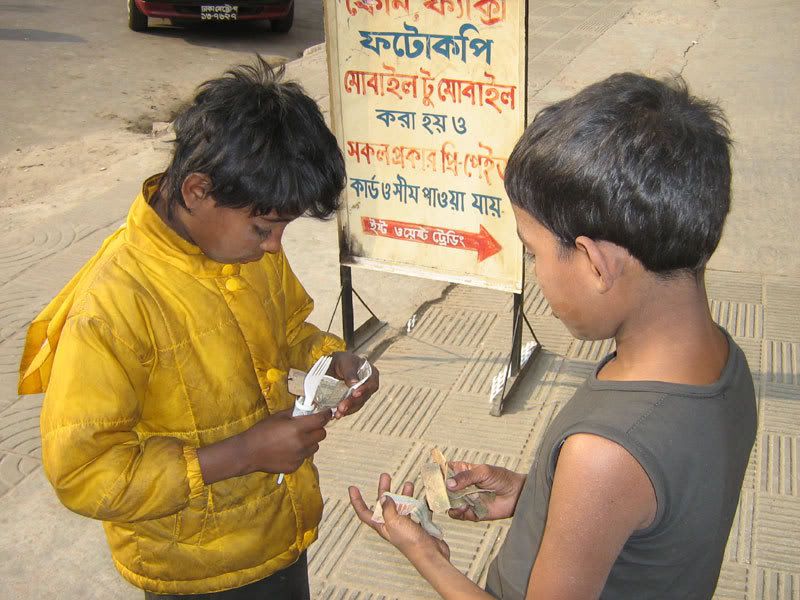
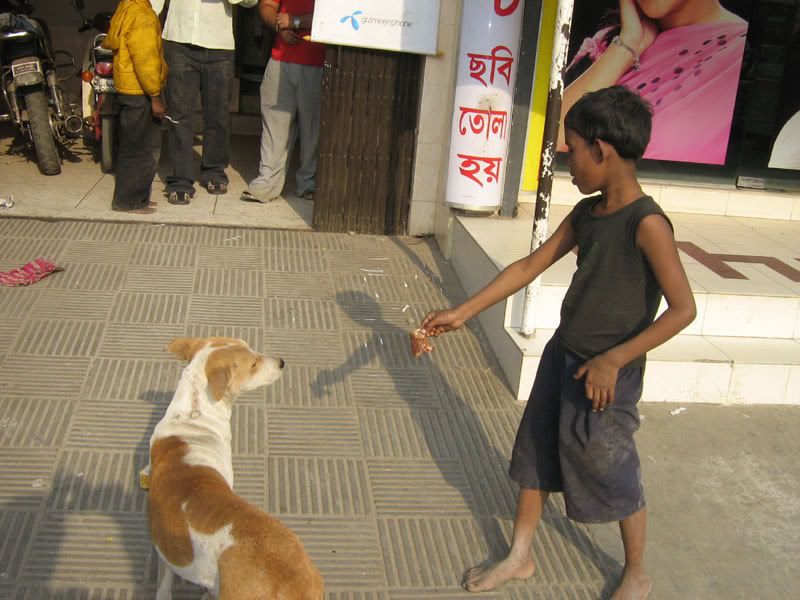
Street children in Dhaka city lead a very miserable life. They eat various kinds of things. But from where they get it? Most of them have to face of kindness of people. Some time they have to face the rude behave from people.In these pictures one boy is eating food sitting by a loan place. He also shared it with his companion. He and his companion always share all things. If any one gives some money they also divide it equally.


Globalfootprint has written:
“Some of the children are on the street - they work, play and spend most of their day with other children on the street but have families to return to at night. These children often help the family earn money by working on the streets.
Other children are of the street - they survive without family, entirely on their own, except for the company of other street children or those willing to help and support them.”


Although they eat food by the kindness of others but they have a simple mind to help others. Dear viewers, in this picture you can see that one boy is giving food to the dog.

Wednesday, May 9, 2007

This is test

hello everyone, Nari Jibon Project has started a new blog for developing the skills of the student of Nari Jibon.