Purpose of Narijibon Blog

Nari Jibon Project seeks to increase our students’ and staffs’ abilities through different ways: classes, practice, computers, internet, and now the Narijibon Blog. Readers and writers (our students & staff) of the Blog will both learn about our lives, culture, Nature, activities of people in Bangladesh and the Nari Jibon Project.

Saturday, October 11, 2008

Pictures after Rain

By Mohtarimun Nahar [Bipa]

My friend Tanbirujjaman Tanbir is very fond of natural beauties. Whenever he gets time he takes pictures of nature from his mobile camera. Recently he celebrated his Eid-Ul-Fitre at his village in Rangpur. He took some excellent pictures after rain from there. Now I will share those pictures with all the bloggers.


Friday, October 10, 2008

My Best Friend

By Ayesha Sanjida Synthia

Way in life we get many friends. Some of them are true friends. One of them can be a best friend. It means a special person who helps us where we need, stay with us when we are very sorrowful or happiness.

I have a best friend in my life. Her, name is Sadia Alam. Her nick name is Chadni. She is 15 years old. She was my classmate. Recently, we passed our S.S.C exam & she got GP- 4.00. Now, she admitted herself in Motijheel Model College in Dhaka. Chadni has a small family with four members. She, her younger sister & her parents are the members of her family. Her father is an A.S.I of Police department & her mother is a house-wife.

She is a very good girl & very helpful. She takes care of me very much. We have good understanding. She is very naughty. Nobody, can get angry on her. Chadni’s favorite color is white. Her favorite food is burger; fruit is litchi & flower is tuberose. Her favorite place is her bedroom. Her hobbies are watching TV, playing cricket, gossiping with friends, reading books, etc.

In future she wants to be a journalist. So, she wants to make strong educational back ground. Now, she works more hard to reach her dreams.

She likes to make fun with everyone. She helps me or other friends to give us good advices. So, I like her very much. My best wishes are for her. I feel very proud that she is my best friend.


Thursday, October 9, 2008

The English Sections of Nari Jibon Project

Mohtarimun Nahar [Bipa]
[The Supervisor of English Section & Editing]


Nari Jibon Project provides alternative skills for girls & women. Actually it is a training program. The Executive Director of this Project is Kathryn B Ward. She is a Professor of Sociology and Women’s Studies of Illinois University, Carbondale. She started this project in March 2005 in Dhaka, Bangladesh. Funding comes from her and her mother Pat Ward and nominally from the students’ admission fees and other donations.

Here different aged of girls and women can take courses on English, Bengali, Tailoring, Computer Office Program, Graphics and Photography etc. Most of the students are of school, college and university levels. Also sex workers can get admitted in English, computers or any other sections in Nari Jibon.

Here we have Nari [Women] Cyber Café only for girls and women. Students are to submit their assignments to the related teachers and practice on English and Computer in this cyber café.

We have also a Blog Project in English [titled “Bangladesh from Our View” [http://narijibon.blogspot.com] and Bengali [“Amader Galpa (Our Stories)” [http://banglablog-narijibon.blogspot.com ] to enhance students’ & staffs’ creativity on different areas.
To know more about Nari Jibon Project you can visit-- www.narijiobon.com.

In Nari Jibon Project we have two English sections: English-1 [Basic Grammar, Reading, Writing and Speaking] and English-2 [Advanced Speaking, Reading & Writing]. Beside those two Practice Classes[Special English Spoken Practice Class] are held on Friday and Saturday morning.

I am the teacher of these sections. Some times many visiting teachers come to take English classes to encourage the students. The students are to attend in the English Sections before taking the computer course. Before admitting here students are to attend an admission test and their sections are decided on their results.

After every three/four month’s guardian meetings and prize giving ceremony are arranged. We also arrange blog workshop by experienced people. Now I will give some descriptions about Nari Jibon English classes.

English-1 [Basic Grammar, Reading, Writing and Speaking]:
Teacher: Mohtarimun Nahar (Bipa)

Course objectives:

• Students will learn Basic English vocabulary.
• Students will learn Basic English grammar rules.
• Materials mostly given in English (immersion).
• Practice on speaking, writing, reading, and understanding will be assigned in each class.
• Students will be able to: read, write and speak.
• Remove students’ hesitation on speaking.
• Students will contribute to the English blog.
• At the end of the course, students will be prepared to move to English 2.
Course requirements:
• Students must know the English alphabet before attending this class.
• Students will do their homework as requested.
• Students will develop their portfolio and plan.

Students will diligently attend classes, and provide adequate reasons for absence. They will be required to make up missed work.

English-2 [Advanced Speaking, Reading & Writing]:
Teacher: Mohtarimun Nahar (Bipa)

English 2 is the final course in English at Nari Jibon. Students who have completed English 1 and have passed a competency exam (oral and written) are eligible to join this class. English 2 is taught completely in English, and each class includes elements of speaking, reading, writing and comprehension. Students are expected to submit homework assignments as required by their teacher, to attend class regularly, and to sit for exams as scheduled.

Course objectives:

• Students will improve their English vocabulary.
• Students will improve their English grammar rules.
• Students will be able to: read, write and speak.
• Students will increase their confidence when conversing in English.
• Students will contribute to the English blog.
• Students will develop their portfolios.
• Students will complete internships.
• At the end of the course, students will be able to hold a conversation with a native English speaker, read and understand English writing, and write grammatically correct memos, essays and prose.

Rules of English- 1 & 2:

• The course will be finished within two months [English-1 within 24 classes and English- 2 within 16 classes].
• Students are required to purchase a cyber café pass card and complete their homework in the cyber café, at least one hour per week.
• Class Days & Time:
English-2: Wednesday & Friday [03.00 am – 05:00 pm].
Special English Spoken Practice Class: Saturday [11:00 am – 01:00 pm].
English-1: Tuesday, Thursday & Saturday [03.00am – 05:00pm].
Special English Spoken Practice Class: Friday [11:00 am – 01:00 pm].
• Keep the mobile on vibrate in the class.
• Students will submit their assignments by sheet or through email.
• In every class, speaking will be practiced on different topics.
• After graduation, students will have to finish the internship program [for two weeks].
• If students miss more than one week of English class, they will be dropped from the class.
• If students refuse to turn in homework for more than two weeks, they will be dropped from the class.


The practices are done by:

Speaking

To be able to speak in different places on different topics and practice from diagram.

Writing

To be able to write paragraph, applications, cover letters, bio-data etc. and make portfolio.

Reading

To be able to read any passes or paragraphs fluently and the pronunciation will be corrected

Listening

To be able to understand English by listening and answer from given questions on that.

Question Answering

To be able to make questions and answer to those. Students will practice by answering some questions to one another and ask about class room objects.

Submitting assignments

Students submit their assignments on class related topics and BLOG. They will type in cybercafé and submit those through email to: mn.bipa@gmail.com ; bipa19@yahoo.com

Browsing internet

Students will browse some website and blogspot site and submit assignments as required by the teacher.


Some Pictures of English Class & Students of Nari Jibon:

I am [yellow dress] with the English students in Blog Workshop

Lee Goldman is in the English Class

A student is taking her prize from Mr. Rafiqul Islam [Project Director of Nari Jibon]

Sufia [NJ student] with the visiting Teachers [Aruna, Muniyat, Stella and Lee]

Lee with the English Class Students

Stella is in the English Class

Lee Goldman, Stella and Aruna are in the English Class

Stella, Muniyat and Aruna are in the English Class

The Visiting Teachers of Nari Jibon Project

By Mohtarimun Nahar [Bipa]
Supervisor of English Section & Editing
Nari Jibon Project

Nari Jibon project is a training program. In Nari Jibon Project we have two English sections: English-1 [Basic Grammar, Reading, Writing and Speaking] and English-2 [Advanced Speaking, Reading & Writing]. Beside these classes two Practice Classes [Special English Spoken Practice Class] are held on Friday and Saturday morning. I am the teacher of these sections. Some times many visiting teachers come to take English classes to encourage the students.They do a great job. Students enjoy a lot to attend the class with them. That’s why I would like to introduce our visiting teachers with all the bloggers.

Shaina Hyder

She is Sociology major at Florida State University. She is most interested in gender and work.

Stella

She is from Canada. She is BA in Asian Studies, Masters in Education and PHD in Multicultural Studies [Specialization in Theatre]. She worked as a University Professor at Lesley University in Boston, University of Phoenix and Skogit Ualley College. She taught Philosophy, Theatre, Education, Ethics and Communication etc.

Aruna Dahal

She is the students of the American International School at Dhaka. She has a sister and a brother. She is sixteen years old. She decided to come to help out the women centre as part of her service hours. She has lived in many countries, such as- Nepal, Cambodia and Laos etc. She thinks Dhaka has been an amazing experience for her especially when she gets to come to help such wonderful women.

Muniyat Haque

She has lived in Canada. She studies in AIS/D. She wants to study in Economics and be an Economist.

Lee Goldman

She teaches math at the American International School at Dhaka. She has a husband and two children. She came from the United States in Virginia. She came to know about Nari Jibon from her friend Rick Davis. In the States she was a teacher in a girls school

Wednesday, October 8, 2008

Memorable Day

By Ayesha Sanjida Synthia

In the last winter of 2007 I went to National Zoo with my family. The zoo is situated in Mirpur. We started our journey at 6 o’clock. We reached at the zoo at 7 o’clock. It was a great pleasure to visit the zoo. At first we took tickets. There was a huge rush in front of the zoo. When we got into the zoo I saw, it was staying very hard security in every where. When we entered in the zoo, our joys know no bounds.

At first we went to the den of the monkeys. The monkeys were coming close to us and we were giving them chips, nuts and banana. The monkeys were enjoying the foods. Then we visited to the den of the tigers and the lions. In the mean time we got tried and sit down to take some snacks. After that we saw the giraffe, zebra, rhinoceros, hippopotamus, crocodile, tortoise, different kinds of snake and python. The zebra looks nice. As it was winter, the zoo lake was full of different birds. I saw the peacock, crane, kingfisher, vulture, cuckoo, parrot, mynah, nightingale, owl, eagle, kite, woodpecker, goose, duck, cockatoo and our national robin. The jiraf looks awesome.

In the zoo we also visit to a museum. It was animal’s museum. From the museum I knew about many animals. At last we arrived at the den of the elephants. We also rode on elephant for a short time. It was very enjoyable.

When we finished moving around the zoo, it was about 1 o’clock. We came out from the zoo. We were very tired and thirsty. It was the memorable day in my life.

Thursday, October 2, 2008

Eid Mubarak

cross posted from Techna Tara

Eid Mubarak! Eid Mubarak!! Eid Mubarak!!!


Today is Eid-ul-Fitr. The holy Eid-ul-Fitr is one of the greatest religious festivals of the Muslims. The people elsewhere in the country celebrating this day with due solemnity and religious enthusiasm

In the morning hundreds of thousands of devotees irrespective of rich and poor attended Eid congregations in different Eid gahs, mosques and open spaces. The devotees irrespective of their social status embraced each other representing the alliance among the Muslims, after saying the Eid prayer. Men, women and children wear new dresses in their best greeting to each other and saying, “Eid Mubarak.” Friends, relatives and neighbors visited each other’s houses, exchanging Eid greetings.

May the blessings of Allah fill your life with peace, joy and prosperity in this Eid day. I wish all of the blog readers a very very Happy Eid day.

Friday, September 19, 2008

Nari Jibon is an appropriate place for your Jakat or any other contribution/donation

By Golam Rabbany Sujan (Sujan's Chinta)

There are many organizations that are committed to develop women or vulnerable women in the world. Some of these organizations provide money to women in the hopes of making them self-reliant. These organizations also report that those women are running business or being self reliant using their money. But we can see that often, their money is used by their husband or other male persons. But Nari Jibon does not give them current money. Nari Jibon gives skill training and makes them able to be self reliant or sometimes helps them for being self reliant. As an example Nari Jibon provides tailoring skills including business knowledge. Nari Jibon provides cloth and students make most of the items during class and internship. Students also visit some tailoring business centers. Then sometimes Nari Jibon provides some money for sewing machine and some business set up cost. Nari Jibon authority also follows up on their progress. Similarly, the other section provides computer knowledge. Students in this section will also learn how to write a standard cover letter and resume, as well as create a portfolio. She will use cyber café for practicing and visiting various web pages and blogs from where she will increase her computer and English knowledge. Every student will open an e-mail account and also students will write blogs. By the reading and writing blogs, students can increase their knowledge and skill more in English and computer programs. Thus students become fit for job.
About Nari Jibon:
Nari Jibon is a non-profit charitable service organization. It is working in South-Dhaka, Bangladesh since 2005. Nari Jibon provides services and support to the women students and workers of low and mid-level families. Nari Jibon provides basic educational and technical skills for employment, income-generation, empower and business development. Nari Jibon provides Bangla primary education to the illiterate women, tailoring cutting and sewing master course, English-1 and English-2 (spoken) and computers (MS Office Programs, graphics and webpage design, photography, and hardware trouble shooting and program maintenance).

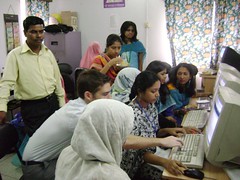
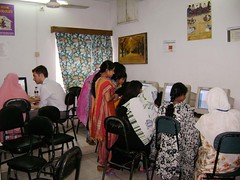
Nari Jibon computer lab
Nari Jibon cyber café


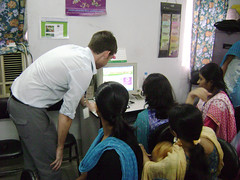
David Sasaki, Director of Rising Voice teaching students about blogging

Nari Jibon English class

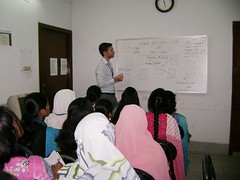
English volunteer teachers (Stella and Lee Goldman) are taking English-2 (Spoken English)

Difference of Nari Jibon skill training programs

1. Nari Jibon is safe place for the women

2. Nari Jibon takes only nominal registration fee for all the courses.

3. Computer students have to have English knowledge or have to learn English at Nari Jibon as it is most essential for related job.

4. Students must use Nari Jibon’s cyber café to have more practice, visiting more web sites, reading and writing blogs and learning other online activities.

5. Nari Jibon motivates students to read and write posts for blogs as it improves students’ knowledge in English and computer. If students want to continue blogging they can open individual blog sites.

6. Often students are trained by some foreigner experts besides Nari Jibon internal expert instructors.

7. All the students will write their own portfolios by themselves.

8. Scholarship students will communicate with individual donors writing thank you letters and monthly progress reports.

Why you should donate for women only.

After being married women are excluded from their parents’ wealth. If any woman becomes a widow at her young age, she is bereft from her husband’s wealth. There are many divorced women who are neglected by her parents’ family. Some male persons take more wives and so that those women are neglected by these husbands. We can see some husbands leaving their wives and hiding them. Some husbands demand dowry after marriage and torture their wives. Some husbands try to pressure their wives into the informal sector. Some low and mid-level families are not interested in spending money for their female members/daughters. And there are fewer job opportunities for the women in our country. So women need more skill training/ education scope to protect themselves and compete against male students as we know that sons get more scope for education than the daughters.So Nari Jibon can be your appropriate place for donation or Jakat. If you donate to Nari Jibon, you will be informed how your donation is spent. As an example if you donate above $10 dollars, you will get thank you letter, picture of students and progress report and successful history.


How and how much money you donate-

You can donate students’ registration course fees, Microsoft Office Program- $17 including 4 cyber passes, Graphics and Web design course $24 including 6 cyber pass cards, photography course $13, Bangla course fee-$1.50, tailoring, cutting and sewing Master Course fee-$5. (These amounts cover only the admission fees that we charge. It costs us much more to actually provide the services, so any extra amount that you can give is much appreciated.)You can provide some money as conveyance with registration fee or you can donate a sewing machine to a poor or vulnerable woman. Nari Jibon has a special scholarship program named LPC (work-study-women) program. Some women need to earn money to survive and they also need to learn skill to change their career or profession. As an example one housemaid or sex worker or poor (dropped out) student who is strong determined to change her profession but she needs to earn money to survive. If she gets LPC scholarship, she will be free to learn skills. She will learn skills and she will also take practical work experience at office. Thus LPC students will make her more fit for jobs and she will also communicate with the employers during course duration. LPC students get $ 50 dollars per month so totally she will get (50 X 4 = $200) Or you can also donate some money to continue Nari Jibon activities such as you can donate a computer or UPS (uninterrupted power supply) or one month electricity bill or rent.
Unrestricted-open ended donations of any amount also towards general costs also welcomed!
Tax deductible donation- make check out to Give2Asia, donation form (must use credit card via website and/or mail in)
For more info on gift list, please visit Nari Jibon USA web site and check the link “possible gift list Nari Jibon” or communicate with Dr. Kathryn B Ward
Donors should also email Dr. Kathy Ward pagol.nari@gmail.com for gift specifics-purchase and also so that we have donor’s contact-email info.

Saturday, September 6, 2008

Nari Jibon: Using Blogs to Give Bangladeshi Women New Skills

Cross posted from Rising Voices


The words “Nari Jibon” should be familiar to regular Rising Voices readers. The Dhaka-based project which has integrated blogging and citizen media into its English and computer classes has been covered frequently on Rising Voices in the past. In this video, we hear directly from the students and staff to get to know the individuals behind the blogs.

Saturday, August 30, 2008

Nari Jibon 4th blog workshop - August, 2008

Yesterday, 29th august 08 was the 4th blog workshop of Nari Jibon project. David Sasaki, Director of Rising Voices was conducted this workshop. There are 15 bloggers and 4 staffs were present in this workshop. The motto of this workshop to increase student’s knowledge as well as to make them more advanced in blogging.

In this workshop, David Sasaki discussed and gives different tips & examples that how to use web link and technorati.com. He also showed the bloggers/students how to use it. He discussed about different search engines and shown them how to make link using html code. Through his discussions and showing examples on weblink & technorati.com to the students/bloggers, they are now well known & more effective about the web link. Now they can use it in their own blog.

Some pictures of this workshop:


David Sasaki discussing on web link and Technorati.com.


David Sasaki showing the bloggers how to make link in their post.

Video of this workshop:


Really, it was a great workshop for Nari Jibon. We are very pleased to meet with him in a person and earnestly thankful to him.

Sonargaon

Cross posted from Techna Tara

Sonargaon is one of the most historical place and oldest capitals of Bangladesh. “The city of Panam” is another name of Sonargaon. Among the ancient monuments still intact, are the tomb of Sultan Ghiasuddin (1399 - 1409 A.D.), the shrines of Panjpirs and Shah Abdul Alla and a beautiful mosque in Goaldi village. A Folk Art and Crafts Museum has also been established in Sonargaon. It situated in Narayongoan district on the Dhaka-Chittagong highway about 29km away from Dhaka.

I have visited Songargaon two times in my life. First I visited some places of sonargaon and sonargaon museum when I was a school going student. Just I can only remember that I saw some statues in sonargaon museum and that time I can’t clearly understand what that was. In my university life I again visited this place in second time with some of my friends. Than I could understand the worth of Sonargaon museum. This time I not only see the statues in this museum, but again & again I tried to find-out more of our cultural wealth’s of Bangladesh on those statues and other archeological things. Really I enjoyed this time very much.

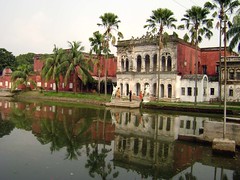
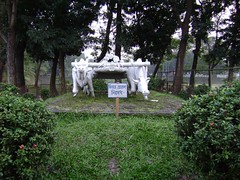
Picture has taken from outside of the sonargaon museum.

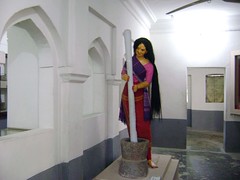
This is one of statues picture inside of sonargaon museum
where Chakma people with their dress and some materials.


This is another Statue of Chakma people, where they are working on paddy field.

In this picture one statues woman working with her
rice making machine and this is vas system to get rice from paddy.


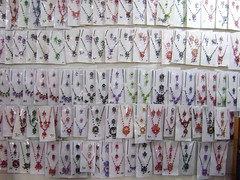
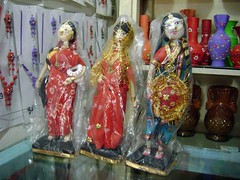
I love to read books and I passed sometimes in the library of sonargaon museum area. In the area of sonargaon museum, there are some small stalls with handicraft where found various ornaments & shari for women and other household materials for commercial sells.

Lucrative showcase items for sell in Sonargaon museum area stall.

Soil made ornaments are displaying here for sell.

Dolls & others ornaments made by soil are display here for showcase use in home.

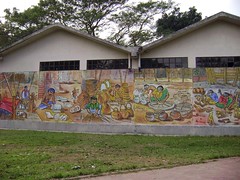
An art on the outside of museum building of Sonargaon from our village cultures of industry.

Front side of Sonargaon museum.

A great Statues of Zainul Abedin, the great artist of Bangladesh
selected Sonargaon to establish Folk Arts and Crafts Museum.

Many visitors from home and abroad come to visit this historical place for enjoy & to knowing about cultures of Bangladesh.

Dr. Kathy's mehendi colored hands

Bangladeshi girls are designed their hands with mehndi in special occasion such as Eid day, wedding ceremony, 1st day of Bengali new year, first day of spring etc.

Dr. Kathryn B. ward likes mehendi, mehendi color and its smell. She likes to design her hand with mehendi. Watch more from video.

What is the biggest celebration of your community each year?

Nargis Sultana
ID: 886
English Section

Pahela Baishakh, Eid festivals, international mother language day, victory day etc are the biggest celebration of our community each year. But Eid festivals are the biggest religious festival of the Muslim across the world. Eid means pleasure. Eid festivals bring happiness to the Muslims. There are two Eid festivals. They are Eid-ul-fitr and Eid-ul-azha. Eid-ul-fitr comes out after the holy month of Ramadan. After the month of Ramadan the first day of Shawal is the Eid-ul-fitr festival. In the morning of the Eid day I found my mother and sisters preparing different kinds delicious items of food and sweets. In the morning I wake up and said my Fazr prayer. I went to the pond and took my bath with sweet smelling soap. Then I came to our house. I ate some sweets. Then I and my brother put on new dresses. My brother took his prayer at the Eidgah Masque. He found people coming to the maidan [field]. He saw the Imam was speaking about the significance of month long fasting and the Eid-ul-fitr. Some delicious foods were cooked at our house. Eid-ul-Azha is quite different from Eid-ul-fitr. After two months and nine days Eid-ul-Azha comes. It is particularly an occasion of sacrifice. Animals are sacrificed by the name of God and the poor get a share of the meat. I got much pleasure. Thus I spent the afternoon. I think Bangladeshi people celebrate theses two days like me. So Eids are the biggest celebration of our community.

What is the biggest celebration of your community each year?

Taslima Akhter
ID: 885
English Section

The biggest celebration of our community is given below:

Eid festival is the biggest celebration of our community each year. There are two Eids. Eid-ul-fitr and Eid-ul-Azha. Last year I celebrated the Eid-ul-fitr with due religious solemnity and purity. In the morning of Eid day I found my mother and sisters preparing different kinds of delicious items of food and sweets. In the morning I woke up and said my said Fazar prayer. After getting bath, I decorated my house. Then I ate some sweets. Then I put on my new dress and helped my mother. Birani was cooked at our house on the occasion. In the afternoon I went to the house of near and dear ones and exchanged greetings with them. I got much pleasure. Thus I spent the afternoon. At night I watched different programs on TV on different channels. Eid-ul-Azha, another religious festival we observed with great solemnity in the world. Last year, my father bought a cow and a goat. I fed them. So, I felt sorry when they were sacrificed. As we are Muslim, we have to follow the rules of Islam. After sacrificing, I went to my friends’ houses to see their sacrificed animals. After one and a half hour, I came back home and helped mother to prepare different dishes. At noon along with my family members I enjoyed the lunch with different delicious dishes. I enjoyed the rest of the day as Eid-ul-fitr. Bangladesh is a Muslim country. We all pass these two Eids with a great joy. So I think Eid festival is the biggest celebration of our country.

What is the biggest celebration of your community each year?

Aklima Akter Akhy
ID: 866
English Section

The biggest celebrations of our community are: Pohela Baishakh, Ei-dulfetor, Ei-dul Azha, Victory day, Independence Day etc. I like Pohela Baishakh. Pohela Baishakh is the first day of Boishakh month [1st month Bengali year]. It is a part and parcel of our culture and we observe this day with great festivity. Baishakhi Fairs are held in the different parts of the country. People of all classes go to the fair. The most comprehensive fair is held at the Ramna Batomul in every year. People wear colorful dresses representing Bengali trends and exchange gifts. Businessmen open new books of account on this day which is known as Halkhata. I go to Baishakhi Fair in every year at Ramna Batomul. I feel very much pleasure on this day. So Pohela Baisakh is the biggest celebration of our community to me.

Tuesday, August 26, 2008

The Biggest Celebration In Our Country

Cross posted from Sristi Kotha

Bangladesh is a non-communal country, where Muslims, Hindus, Christians and Buddhists live together with common indicative Bangladeshi (Bangali). In turn of six seasons in this highly beautiful country, Bangladeshis overwhelm with various kinds of festive occasions such as Pahela Baishakh (1st day of new Bengali year), Borshaboron (reception of rainy season), Nobanno Utsab (celebration with new crops at Hemonta), Pahela Falgun (1st day of spring), Chaitra Songkranti (last day of Bengali year), National mother tongue day, Independence day besides different community’s religious festivals. But I think Pahela Baishakh is the biggest celebration where gay and festive Bangladeshis of various communities hold a festive of one spirit for the devotional reception of new Bengali year.

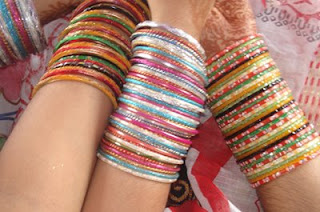
The first day of new year begins by wishing one another saying shuvo nababarsha (happy new year). Every one wears same type of dresses which are combination of red and white.Men use to wear Panjabi or Fotua and women wear Shari, some girls use Slack and Kameez. Girls are ornamented with Bengali adorn. They use henna paste, bangles, various types of ornaments made by mud, flowers etc. Some people use abeer (kind of red powder), some draw alpona on their face or hand. Every one have special food in this day which is panta (boiled rice soaked with water) with fried hilsa fish, uncooked onion, green chili and various kinds of bhorta (one kind of cooked food) of dried fish (preserved by seasoning and drying in the sun), potato, pulse or prawn.


Picture: A Bangladeshi girl ornamented with Baishakhi adorn

Many organizations and institutions arrange rally. People gather in rally with colorful poster, mask etc. Baishakhi fairs and cultural shows are arranged here and there. Various types of toys, pottery, handicrafts, cosmetics, fan (of a palmyra-leaf), sweetmeats etc are available in fair. Jatra pala (Opera) and puppet show are attractive parts of village fair. All cultural functions in this day begins with a song by world famous poet Rabindra Nath tagore which is aso… hey baishakh, aso… aso (come… oh Bishakh, come… come). Cultural functions are resounded by song, dance and poetry recitation. Most colorful and quite attractive fair and cultural functions are arranged at Romona Botomul in Dhaka. Sometimes storm called Baishakhi jhar occur suddenly. Then owners of stores in fair fall in hazard little bit.

Some indigenous people such as Chakma, Marma, Tonchonga and Tripura celebrate this day as their main festival which is called Bijhu. They are overwhelmed with indigenous festival.

Picture: floor decoration

As a Bangladeshi I also enjoy this day with others of one spirit. In my childhood I and my friends bought vandar (one kind of pot made by mud) from Baishakhi fair and saved money in it all around the year and in next new year we bought new dress by this money. It was a great pleasure to me. In this day we were walking about in the village fair. Riding in Nagor- dola and designing hands with color were the main attraction for me. When I was a student of college, then I and my friends gathered at college campus at the starting of day and then traveled by boat in the river called Bhairab. We passed our time with singsong, gossip, laugh etc. At afternoon we went at fair. The years after that I was a resident of Rokeya hall at University (KUET) and here pleasant drowsiness of festival for reception of new year begins at previous night of this day. Some girls were busy with rehearsal of sing song, poetry recitation, some were busy with making poster, some were drawing alpona (floor decoration of sprinkled rice flour) at hall courtyard, some were busy with designing their hands by henna paste, some were making cake for stall, some were going for festooning campus with posters. The night was passed in this way. At morning festival was started with cultural function. Some girls put mark of sandal paste on the forehead of others during the function. At the end of function we took special food for Pahela Baishakh. Then we went to the stalls held by some students of the university and after that we walked about various place. We also enjoyed film show at university auditorium.


Picture: Designed hands with henna paste


Picture: Hands are ornamented with bangles

Like me all Bangladeshis enjoy this day. At one time this day takes farewell from us but it offers new dreams for new days and says, “happy every day of new year”.